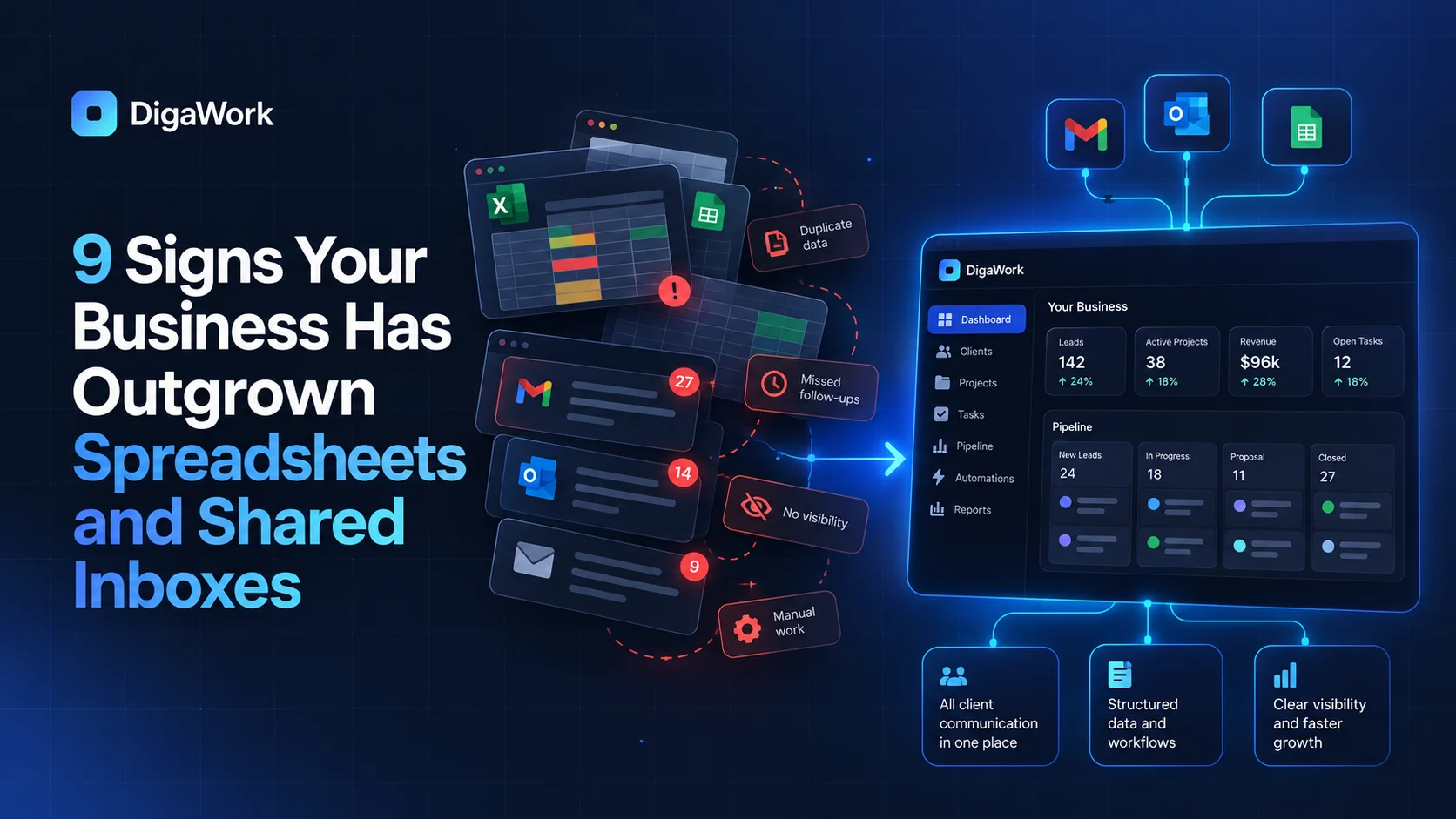
Spreadsheets are excellent tools. The problem is not that a business uses them. The problem is when a spreadsheet quietly becomes the database, task manager, handoff system, reporting layer, and customer record at the same time.
That usually happens gradually. A file that worked perfectly for five customers becomes a workbook with twelve tabs, hidden columns, duplicate copies, and instructions that only one person understands.
1. Nobody is sure which version is current
When files are copied, exported, emailed, or renamed, teams lose confidence in the data. The first question in a meeting becomes 'which sheet are we using?' instead of 'what should we do next?'
2. The same customer is entered in multiple places
A lead starts in a form, gets copied into a spreadsheet, appears in an inbox, and is entered again when work begins. Duplicate entry is a strong signal that the workflow needs a shared record rather than another column.
3. Follow-up depends on memory
If someone has to remember to check a row, send an email, notify operations, or create the next task, the spreadsheet is storing information but not managing the process.
4. Reporting requires cleanup before every meeting
A healthy system should make common operational questions easy to answer. If pipeline, workload, completion status, or source reporting requires manual reconciliation every week, the reporting problem usually starts with how the data is structured.
5. Permissions are becoming awkward
Growing teams rarely need everyone to see and edit everything. Sales may need customer and pipeline records, operations may need active work, and management may need cross-team visibility. Spreadsheet permissions are often too broad or too fragile for those needs.
6. Status values mean different things to different people
One person uses 'pending' for waiting on the customer. Another uses it for internal review. As volume grows, informal definitions turn into reporting problems and missed handoffs.
7. Shared inboxes are acting like a task system
Flags, stars, folders, and forwarded messages can work for a small team. They become risky when the inbox is also responsible for ownership, deadlines, history, and accountability.
8. Customers are asking for information your team has to hunt down
When status, documents, approvals, and next steps live in separate places, customer communication becomes a scavenger hunt. That is often the point where a connected record or client portal starts creating real value.
9. New employees need tribal knowledge to understand the process
If onboarding requires someone to explain which spreadsheet matters, which columns not to touch, which inbox folder means what, and who has the latest version, the workflow is no longer self-explanatory.
What replaces the spreadsheet?
The answer may be a CRM, operations workspace, internal tool, automation layer, or a combination of those. Start with the process that creates the most duplicate work or uncertainty. A focused system that solves one high-friction workflow is usually more useful than attempting to digitize the entire business at once.
If your spreadsheet has become your business system, it may be time to map what should replace it.
See how a connected system can replace the fragile parts of a spreadsheet-driven workflow.