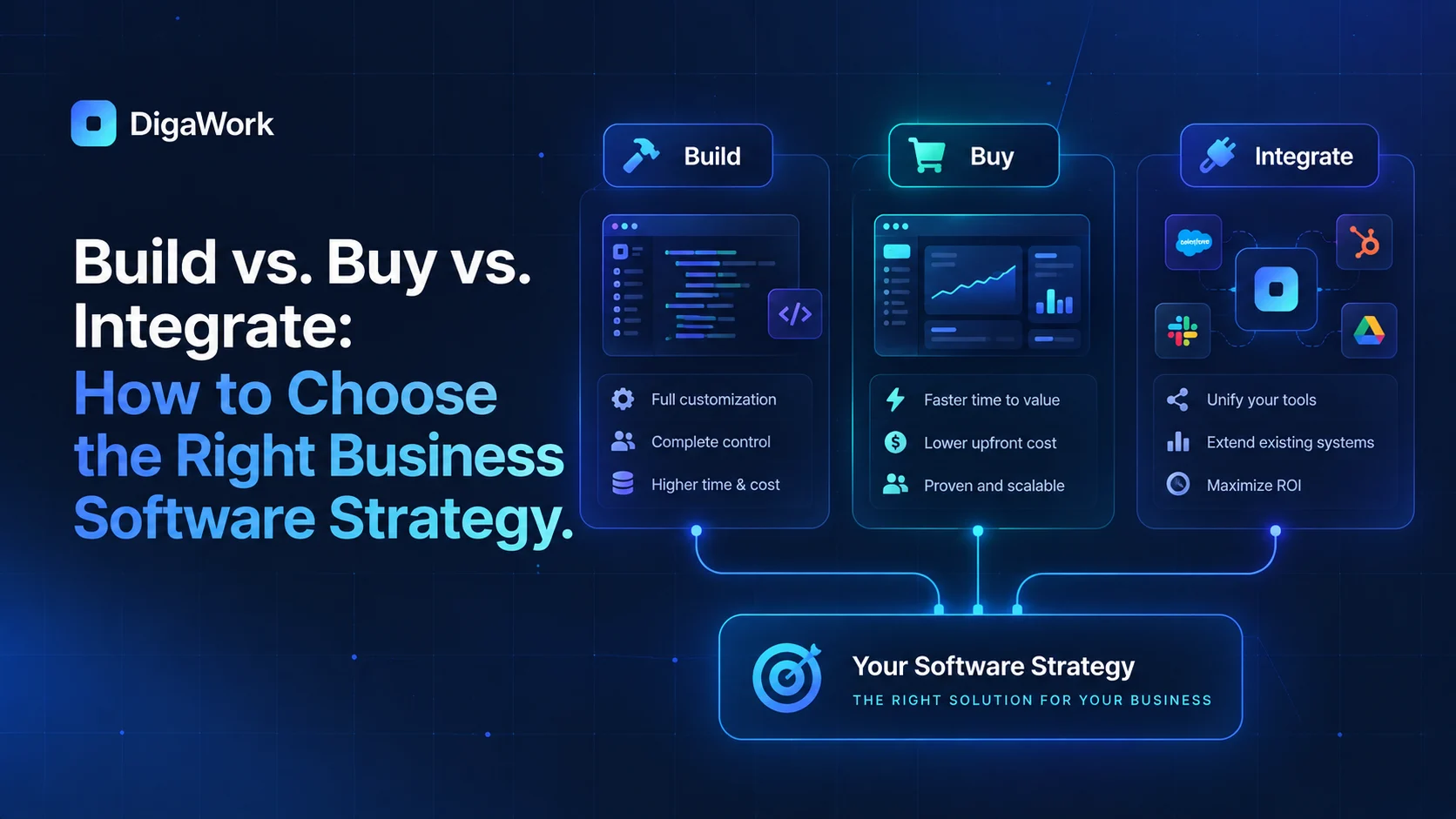
Businesses often frame software decisions as build versus buy. That misses a third option that is frequently the most practical: integrate.
You may be able to keep a strong accounting platform, keep your calendar, keep a specialized industry tool, and build only the workflow layer that those products do not provide.
Option 1: Buy
Buy an existing platform when the workflow is common, speed matters, the product already solves the problem well, and adapting your process to the software does not create expensive friction.
Option 2: Build
Build when the workflow itself is specific to your business, standard software requires too many workarounds, data relationships do not fit packaged models, or the system needs to become part of how the company competes and operates.
Option 3: Integrate
Integrate when the individual tools are useful but the handoffs between them are the problem. The goal is not to force everything into one database. The goal is to make information and actions move without repetitive manual coordination.
| Question | Buy | Build | Integrate |
|---|---|---|---|
| Is the process standard? | Strong fit | Often unnecessary | Useful if tools are fragmented |
| Need to launch quickly? | Strongest | Slower | Often moderate |
| Need unique workflow logic? | Limited | Strongest | Strong if logic sits between systems |
| Existing tools work well? | May replace them | May replace selectively | Best when tools should stay |
| Need one source of workflow truth? | Possible | Strong | Possible with a central layer |
Use Keep, Connect, Automate, Replace, Build
A more useful software strategy evaluates each part of the current stack separately. Keep what is working. Connect systems that need to share data. Automate repetitive handoffs. Replace tools that create more friction than value. Build only where custom software creates a meaningful operational advantage.
Avoid rebuilding mature infrastructure without a reason
Payments, accounting, email delivery, calendar infrastructure, and other mature services can be expensive to recreate and maintain. Custom software should usually sit around those capabilities rather than duplicating them unless there is a clear business reason.
A simple decision test
List your core workflows and rate each current tool on fit, reliability, integration access, cost, and importance. The parts with strong fit should usually stay. The gaps between tools, repetitive handoffs, and workflow-specific requirements are where custom development deserves attention.
Not sure what to keep, connect, automate, replace, or build?
See how DigaWork approaches connections between the tools you want to keep.